
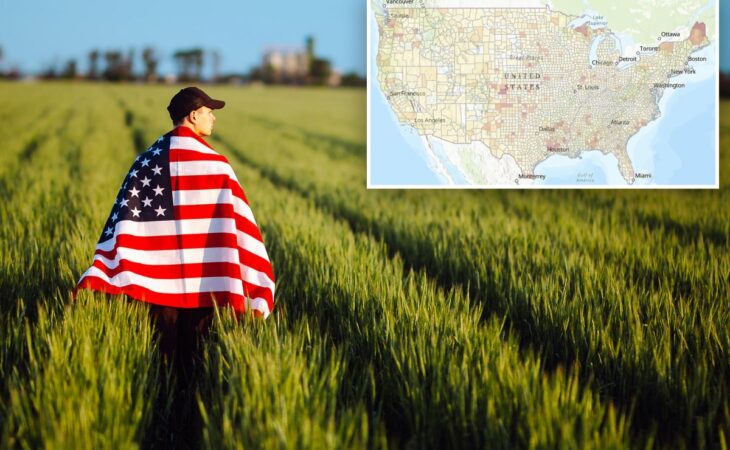

Millions of acres of farmland across the country are privately owned, but a small share of it is foreign-owned land sitting idle in many areas.
That’s according to new U.S. Department of Agriculture data which shows just how much of the nation’s agricultural land is owned by other countries.
The USDA‘s online portal reveals that more than 45 million acres of land are owned by foreign countries, with an original purchase value of over $38 billion. Our neighbor to the north, Canada, has the most agricultural acreage in the United States, at 15.35 million acres.
John Hewlett, a farm and ranch economics management specialist at the University of Wyoming, doesn’t find this surprising. Rather, he points out that not many know this farm fact.
“Many people are surprised to learn that Canada is by far the largest foreign holder of U.S. land (owning about 33% of the foreign total),” Hewlett tells Realtor.com®. “Followed by the Netherlands and Italy. Because these are long-standing allies, their ownership of timberland or wind farms rarely causes a stir.”
The Netherlands owns 5,197,940 acres of agricultural land, and Italy owns more than 2.7 million acres.
Whether this is a concern or not when it comes to agricultural land owned by foreigners, Hewlett says the “who” depends on what they are trying to protect.
Hewlett breaks it down into three categories:
In Wyoming, where Hewlett is based, over 260,000 agricultural acres are foreign-owned, but that is minuscule compared to other areas.
Among the states with the most foreign agricultural land investors are Texas (5,775,516 acres), Maine (3,512,624 acres), Colorado (2,477,247 acres), Alabama (2,210,274 acres), Oklahoma (1,829,711 acres), and Washington (1,787,990 acres).
In Maine, the northernmost state along the East Coast, where nearly 3.5 million acres are foreign-owned land, there’s not too much concern about losing green space to housing developments.
“It’s kind of a misnomer, though, because in Maine, what’s considered agricultural land is actually working forest, like timberland,” Michelangelo Floridino, real estate broker with Landing Real Estate in Portland, ME, tells Realtor.com.
Floridino describes the Maine terrain and what it’s like near the Canadian border.
“Once you get about an hour of the border of New Hampshire and Maine, it’s a lot of private roads,” he explains. “Once you go a couple hours north, you might not have power. You might not have paved roadway to even get to these parts of Maine.”
He says there’s not much worry if a foreign investor were to try to turn the agricultural land into infrastructure, because of the changing the landscape.
“You can’t build houses up there,” says Floridino.
As for Canadians snapping up Maine real estate, he says he hasn’t been seeing much of that lately.
“I get more people from Massachusetts. I just had one call a couple of weeks ago from Oklahoma who was coming back to Maine. Another one I had was from North Carolina,” Floridino adds.

Leave Your Comment