
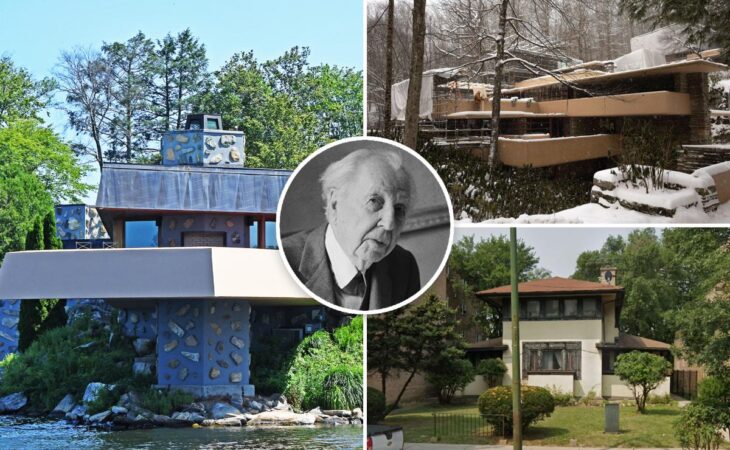

Frank Lloyd Wright remains a major figure in the history of American architecture. But when it comes to maintaining his surviving homes — well, that remains a major pain in the neck.
Take Petra Island in upstate New York, with a 5,000-square-foot wood and concrete main house built from Wright’s original plans.
The house was completed in 2007, decades after Wright died in 1959 at age 91, and yet it inherited many of the same quirks as the homes Wright built himself — including a flat roof that leaks and oversized fireplaces that smoke as much as they impress.
“The house is magnificent, but it has some faults in the design,” owner Joe Massaro, 80, a former sheet metal industrialist, told The Post as he stepped into its foyer — where a centuries-old boulder forms one of the walls. “He was not a great engineer, but he wanted what he wanted.”
Frequent, painstaking maintenance is a constant for owners of Wright’s roughly 400 still-standing houses, many of them concentrated in the Midwest. As stewards of the architect’s uncompromising vision, they preserve designs that often prioritized artistry over practicality — an effort that can require serious work.
After all, things were different in Wright’s day. In 1920, while Wright was rising to fame, just 20 states required architects to be licensed, according to the National Council of Architectural Registration Boards.
Wright founded his own firm in 1893, before Illinois established its law requiring licensing for architects without earning an architecture degree. Instead, he entered the profession through apprenticeship.
Still, what Wright lacked in formal academic training, he made up for with abundant creativity.
“He wanted a more organic structure, for people to feel like they were more tied to nature,” said Dan D’Agostino, principal and founder at New Jersey-based PLAN Architecture, who’s spent decades studying Wright and his structures. “The idea of bringing stone into a house, that wasn’t really done before Wright.”
To blur the boundary between inside and out, Wright filled entire corners with windows or had grooves cut directly into stone so panes of glass could be fitted without the need for window frames.
“Wright was handed engineering reports with these calculations saying his designs were not going to work, and he would say, ‘You must trust the process. If you’re not going to trust me, I can quit,’” D’Agostino said. “His bravado would get in the way.”
The 11-acre heart-shaped Petra Island in Lake Mahopac — which Massaro purchased in 1996 for $750,000, including the value of a house he traded for it — sits about a mile offshore, boasting two dwellings tied to the mid-century architectural mastermind. Notably, the main house resembles a ship; its 75-foot concrete terrace cantilevers over the water, as though riding a wave preserved in time. Nearby sits its shy sibling, a guest cottage Wright completed in 1949 that’s hidden from the view of passing boaters.
Among the materials used for the main house was five times the amount of African mahogany that Wright used to build the guest cottage.
Every 10 years, Massaro hires a local handyman, Daniel Corbi, to sand and stain the exterior wood enveloping both houses, a project that takes about five years to complete — which costs more than $10,000.
“I’ve been doing this for 20 years or so now, and it’s an honor maintaining it,” Corbi told The Post on a recent break from staining the guest house.
Still, it’s costly — not to mention highly tedious.
Recently, Massaro paid $1,000 each for several 10-foot-by-10-inch slabs of mahogany when some spots needed replacements, he said. To find the correct sealant, he removed a wooden door to the guest cottage and shipped it, carefully, to a specialist in New Jersey.
The challenges of Wright houses resurface in the news every few years, usually when preservationists scramble to save one from the consequences of his uncompromising vision.
Fallingwater, Wright’s highly popular southwestern Pennsylvania tour de force, for example, required an $11.5 million stabilization project to keep it from falling into a waterfall, as its name implies.
In June, Wright’s J.J. Walser Jr. house in Chicago’s Austin neighborhood finally sold for $150,000 after sitting abandoned and deteriorating for 30 years. The nonprofit Austin Coming Together has taken on the task of restoring the Prairie School-style landmark, built in 1903, whose many tasks reportedly include structural stabilization, along with roof and stucco repairs.
That being said, Wright’s work still attracts a specific pool of buyers.
The lure of Wright’s designs seduced historic architecture preservationists Marika Broere and Tony Hillebrandt in 2016, when they bought the Eppstein House in Galesburg, Michigan for $368,000. Built in 1953 in Wright’s Usonian style, the 2,500-square-foot three-bed, two-bath property was part of a planned community of Wright homes known as the Acres. In 2021, they purchased the 2,200-square-foot two-bed, two-bath Eric and Pat Pratt House next door for $355,000. Both homes had been abandoned for nearly 20 years prior.
“What we love most is how Wright designed not for grandeur, but for harmony,” Broere said. “His homes are meant to live in. They’re human-scaled, light-filled and deeply personal.”
Romanticism aside, they’re also deeply expensive to maintain.
In their years-long restorations of the two homes, the couple invested more than $1.7 million of their retirement savings into the projects, Broere said. This included $130,000 to repair the concrete textile blocks at both houses, $150,000 on woodwork and another $50,000 to replace the roof on the Eppstein house.
The pair assembled a network of specialized craftsmen, largely thanks to recommendations from the community of Wright-house restorers around the country, Broere added.
At one point, they consulted an expert from the Sherwin-Williams paint company who designed a breathable stain for the concrete blocks, Broere said. In another adventure, Broere and Hillebrandt traveled to a warehouse in Battle Creek, Michigan, where they sifted through dust-covered boxes to find the correct bathroom tiles.
“While we tackled much of the work ourselves, we also employed a master carpenter who worked nearly full-time for several years on cabinetry, window frames and doors,” Broere said.
Satisfied with their efforts, Broere and Hillebrandt sold the Pratt House in the spring of 2024 for $1.8 million, including $300,000 for Wright-designed furnishings included with the sale. The Eppstein House is listed both on Airbnb and for sale for $2.1 million. The couple has since hopped across the pond to their next project, restoring a mid-century villa in France.
Preserving and maintaining Wright’s residential treasures is such a celebrated endeavor that the Chicago-based Frank Lloyd Wright Building Conservancy hands out Wright Spirit Awards at its annual conference.
But John Waters, preservation programs director at the conservancy, noted that all older homes come with their challenges. Many mid-century architects, from Rudolph Schindler to Richard Neutra, built flat roofs that were prone to leaking, he said.
“Wright is the most famous, so he gets the most comments, but any historic house owner is a person who should be lauded for their dedication to preserving the house,” Waters said.
For Massaro, the source of leaks from the roof of the main house are maddeningly elusive.
“I have a leak in the laundry room that leaks when it’s not raining,” Massaro said. “It’s leaked for weeks. I can’t figure it out.”
After a few highly publicized attempts to sell Petra Island, even dropping the price from $20 million in 2012 to $9.95 million in 2019, Massaro went back to his roots as an entrepreneur. He now operates tours to the island, selling tickets at $150 apiece, and has hosted thousands of curious sightseekers, architects and journalists from around the world.
The tours keep him busy, Massaro said, and help recoup some of his financial investment, which includes $120,000 a year on taxes and maintenance for the island and its houses. In between them, he enjoys lounging on the terrace and tinkering with a hologram he built of Wright giving a speech on the design of the main house.
“It’s one of the most comfortable places I’ve ever lived,” Massaro said. “Wherever I am, there’s a view.”

Leave Your Comment